Start with your district policy and the venue
Read your district's written field trip policy, and ask the venue whether it sets its own minimum for school groups. Follow whichever asks for more adults. Two examples: Fairfax County Public Schools in Virginia recommends one chaperone for every ten students on its field trips, and notes that museums, tours and other venues may ask for more, such as one adult for every eight students. United Educators, a liability insurer for schools and colleges, gives no fixed ratio. It says to check state and local rules and the venue's rules while you plan, and that every trip should have at least two chaperones.
What should raise your number
- Younger students, who need closer supervision.
- An overnight stay.
- Travel abroad.
- Physically demanding or riskier activities, such as hiking or time near water.
- Public transport, crowded venues and anywhere students could get separated.
- Students who need one-to-one support. A student's IEP can set this.
- Splitting into small groups at the venue, since each group needs its own adult.
- A spare adult, in case one has to leave with a sick or injured student.
Overnight trips
Plan for more adults than on a day trip, because someone is on duty through the night. If boys and girls are on the trip, bring adults of each gender, so the right adult can do each room check. Check what your policy says about both.
Read more: Chaperone guidelines for the night
Turn the ratio into groups
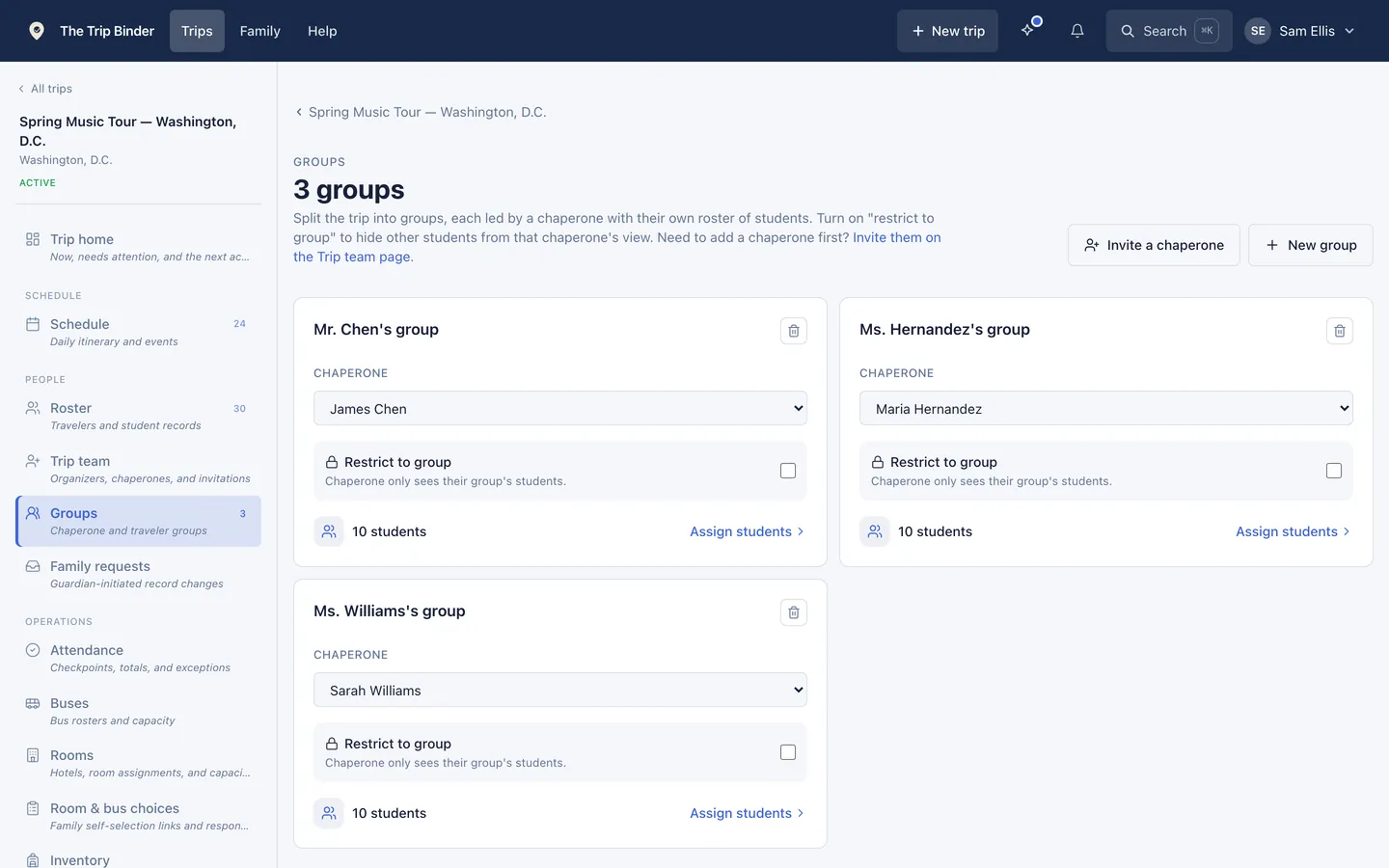
A ratio only works when every student knows which adult is theirs. Give each chaperone one named group.
- In The Trip Binder, each group has one chaperone, and each student belongs to one group at most. A group column in your roster spreadsheet fills the groups in when you import it.
- Turn on Restrict to group when a chaperone should see and mark only their own students, on the roster, in attendance and on the bus lists.
- The roster and attendance lists have a group filter, with My group for a chaperone's own students.
When a chaperone has to leave
A chaperone who stays back with a sick student, or leaves early, leaves a group without its adult. Mark the chaperone away from the group and choose who looks after their group. The group goes back to them when they are marked back with the group.
Count the adults too
Seat the chaperones on the buses as well, so the bus total is the number of people on board and the count-off includes the adults.
Common questions
- What is a typical chaperone-to-student ratio for a field trip?
- There is no single standard. Fairfax County Public Schools, for example, recommends one chaperone for every ten students, and venues can ask for more, such as one for every eight. Younger students, overnight stays and riskier activities usually call for more adults. Your district policy and the venue decide, so check both.
- Do overnight trips need more chaperones?
- Usually, yes. Someone has to be on duty through the night and check rooms, and adults of each gender help when boys and girls are on the trip. Check your district policy for its overnight rules.
- Is there a limit on chaperones in The Trip Binder?
- No. Chaperones are unlimited on every plan, including the free plan for day trips, and chaperones never pay.
- Does The Trip Binder set a chaperone ratio for me?
- No. The app does not set or check a ratio. You decide how many adults to bring, and give each one a group of students.
Sources
- Fairfax County Public Schools: Field Trips (read on Nov 6, 2026)
- United Educators: Determine Chaperone-to-Student Ratios for School Trips (read on Nov 6, 2026)
Run your next trip on The Trip Binder
Day trips are free at any roster size, with unlimited travelers and chaperones. Build the trip on the web, then run it from the app on iPhone or Android.